



MRI Software Showcases Agentic AI and Workflow Automation at Ascend 2026
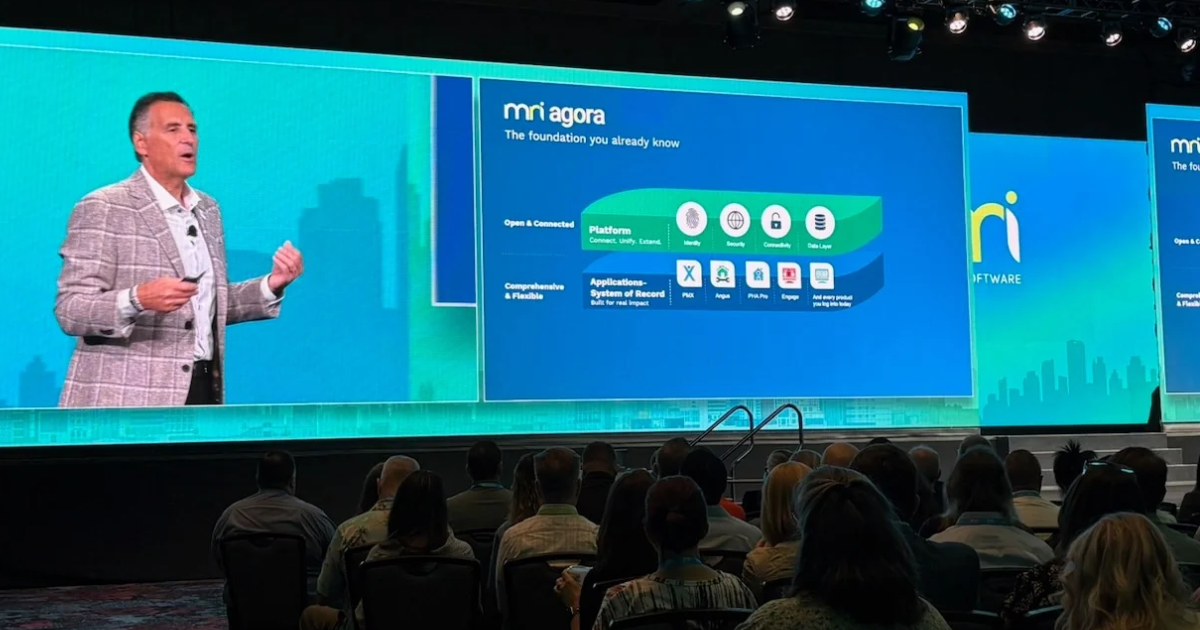
At its Las Vegas user conference, MRI demonstrated how its Agora platform is being developed to coordinate AI agents, automate real estate workflows and connect applications across its extensive software portfolio.
For real estate software providers, the next phase of artificial intelligence may be less about answering questions and more about getting work done. That distinction was central to MRI Software's Ascend 2026 conference in Las Vegas, where the company demonstrated how AI agents could execute business processes across its established property management and accounting systems.
Held October 19–21 under the theme “Possibility at Pace,” Ascend brought together more than 1,500 MRI customers, technology partners and industry professionals. The event offered an opportunity to examine MRI's expanding Agora platform, including capabilities already available to customers and others approaching release. Realcomm attended the conference at MRI's invitation, continuing a relationship with the company that spans more than two decades.

Building AI Around Real Estate Operations
MRI enters the AI era with considerable scale and a deeply established customer base. Founded more than 55 years ago, the company serves approximately 45,000 clients globally, with its applications supporting roughly 5 million leases and 17 million units.
Its software portfolio encompasses property accounting, budgeting, asset management, leasing, facilities maintenance and numerous other functions. Many customers have relied on these systems for decades, creating an environment in which new AI capabilities must coexist with established processes, controls and technology investments.
During the opening general session, CEO Pat Ghilani outlined MRI's approach to this challenge. Ghilani, attending his 20th Ascend conference and 12th as CEO, was joined by Chief Innovation Officer Nihar Malik, who arrived at MRI earlier this year. Their presentation centered on Agora, which MRI is positioning as a common intelligence and automation framework rather than a collection of unrelated AI features.
The strategy is to make AI accessible within the applications customers already use, while enabling increasingly sophisticated processes that span multiple systems.
Agora's Expanding Capabilities
MRI introduced several components of Agora during the conference, each addressing a different aspect of real estate operations.
- Agora Orchestrator was among the most consequential. It provides a framework for coordinating AI agents that can perform tasks, exchange information and advance workflows through multiple steps. Rather than simply suggesting what an employee should do next, the agents can carry out designated actions and request approval where appropriate.
- Agora Intelligence focuses on analytics and decision support, while Ask Agora allows users to interrogate operational data and MRI's knowledge resources through natural-language prompts. The latter draws upon product documentation, release notes and historical support information to help users find answers without navigating multiple systems.
- Agora Voice extends the platform into telephone-based interactions, including residential leasing and maintenance inquiries.
Together, these offerings illustrate MRI's effort to apply AI to specific operational problems rather than treating it primarily as a standalone conversational interface. Other compelling capabilities demonstrated during the conference included MRI Contract Intelligence, which applies AI to extracting and interpreting information from leases and other documents, reducing or eliminating the manual effort associated with abstraction and data entry.
‘Human in the Loop’ Remains Part of the Architecture
A notable aspect of the presentation was MRI's emphasis on accountability as AI agents take on more responsibility. Ghilani and Malik described an architecture incorporating activity telemetry, audit trails and visibility into decisions requiring human authorization. For financially sensitive processes, the company does not envision eliminating human review. This is particularly relevant to institutional owners and operators, where accounting accuracy, compliance requirements and internal approval procedures can vary considerably.
MRI also emphasized workflow configurability. Executives suggested that a library of approximately 50–60 predefined workflows could address 80–90% of common customer requirements, with additional customization available for more specialized operations.
Another architectural decision is MRI's model-agnostic approach. Agora can utilize AI models from OpenAI, Anthropic and Google, allowing different models to be selected according to the task. The longer-term challenge will be maintaining consistent performance and governance as these agents interact with increasingly complex customer environments.
A Leasing Conversation That Illustrated the Potential
One of the conference's more memorable demonstrations involved Agora Voice handling an inquiry from a prospective apartment resident. The AI agent engaged the caller in a natural-sounding conversation, answered questions and progressed through scheduling a property tour. Latency was minimal, the interaction was fluid and avoided much of the scripted feel associated with conventional automated telephone systems. The demonstration generated considerable interest among attendees, many of whom oversee leasing operations that depend heavily on staff availability and repetitive customer interactions.
For multifamily operators, an integrated voice agent operating around the clock could improve response times while reducing routine administrative demands. MRI is confident it can deliver successful deployment and the prospect that these systems can reliably handle substantial portions of the residential leasing process.
Interoperability and the Partner Ecosystem
Ascend also highlighted a dimension of MRI's business that extends beyond its own applications: a substantial network of third-party technology partners. The conference's dedicated MRI Ecosystem Pavilion featured companies specializing in real estate data, tenant screening, payment processing, leasing services, connected building technologies and systems integration.
MRI repeatedly emphasized interoperability through APIs, Model Context Protocol (MCP) connectivity and packaged integrations. These connections have particular significance for agentic AI. An agent's usefulness may depend on its ability to retrieve information or initiate actions across multiple systems, including applications outside MRI's portfolio. For enterprise customers with heterogeneous technology environments, this openness could become an important factor in evaluating MRI's broader AI offering.
From Demonstration to Deployment
 Ascend 2026 provided a detailed look at MRI's AI development priorities, supported by live product demonstrations rather than relying exclusively on conceptual roadmaps. The demonstrations in Las Vegas offered a credible indication of the direction MRI is taking. The more important evidence will emerge as customers put these technologies to work at scale. The breadth of Agora's capabilities suggests a substantial investment in AI orchestration, conversational interfaces and intelligent automation. Ghilani, Malik and the other executives presenting during Ascend continually emphasized reliability, support for complex workflows and the ability to deliver demonstrable improvements in operating efficiency. MRI has the advantage of an extensive installed base, longstanding industry expertise and an established integration ecosystem. Its opportunity (and challenge) now is converting those assets into AI capabilities that perform consistently in everyday real estate operations.

|
Realcomm Staff
Realcomm Conference Group LLC is the leading research and educational institution that produces annual conferences and expositions on technology, automated business solutions and intelligent buildings strategies for executives in commercial, corporate, government and institutional real estate. Realcomm was founded in 1999 with the goal of bringing industry leaders together each year to discuss, demonstrate and debate the latest innovations that impact the industry. |
This Week’s Sponsor
Lynxspring is an innovative industry leader with decades of expertise in building automation, energy management and integrated control systems. We develop, manufacture, distribute, and support edge-to-enterprise solutions and open, scalable, interoperable platforms, customized applications, and data analytics. With nearly 450+ partners and 50,000 devices deployed in millions of square feet of commercial settings in the US and globally, our JENEsys Edge portfolio of programmable controllers are also perfect for facility, equipment, unitary, plant and VAV control. Lynxspring provides smart and economical solutions for building owners/operators, equipment manufacturers and system integrators.
Read Next
 11/11/2026
What Happens When You Ask Your Lease and Ledger Data a Question In commercial real estate, questions tend to arrive before the reports that answer them.
 10/21/2026
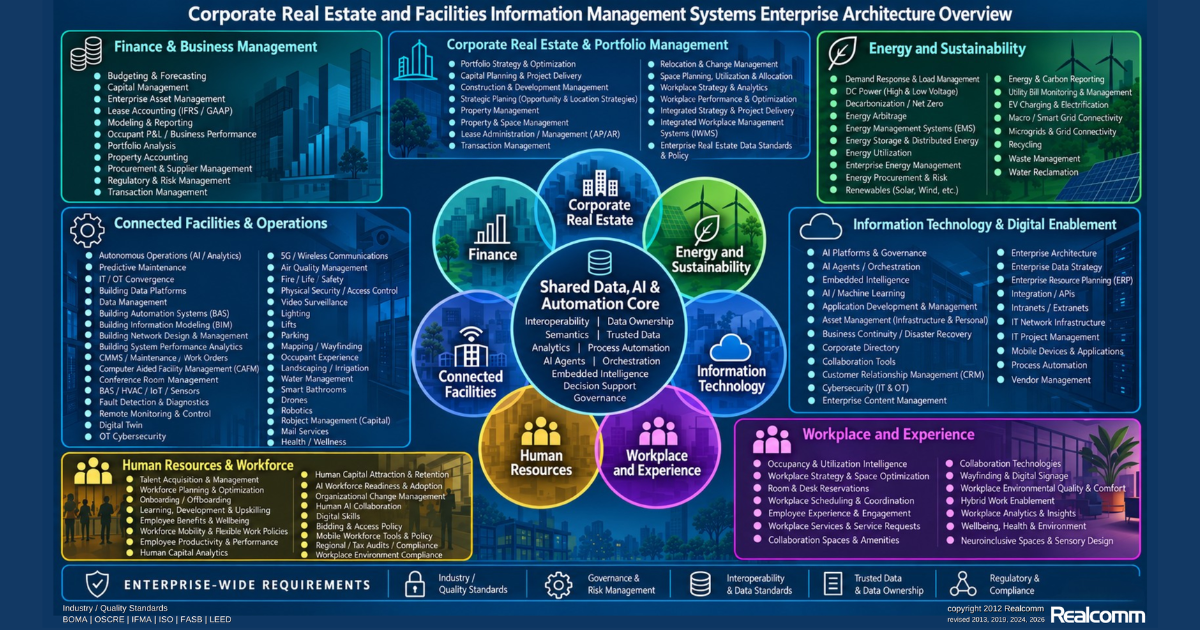
Realcomm Updates Corporate Real Estate and Facilities AI Roadmap: Your AI Strategy Starts with Your Enterprise Architecture Realcomm's updated enterprise architecture framework offers corporate real estate leaders a practical starting point for assessing AI readiness and determining where to focus their efforts.
 10/14/2026
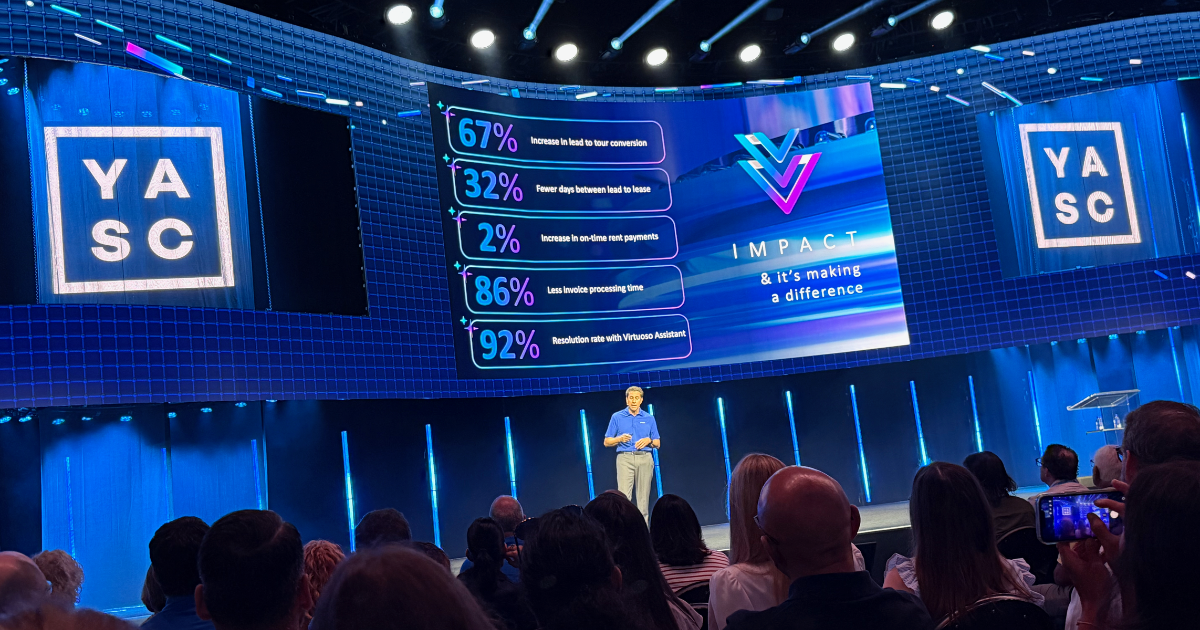
Yardi’s AI Strategy Takes Center Stage at YASC 2026 With the introduction of Virtuoso Enterprise, Yardi is positioning AI as a foundational component of its real estate technology platform, offering customers multiple paths to adoption.
 9/30/2026
The Truth Is in the PDF AI has transformed what we can do with data. So why do we all still live in a sea of PDFs?