



Realcomm Updates Corporate Real Estate and Facilities AI Roadmap: Your AI Strategy Starts with Your Enterprise Architecture
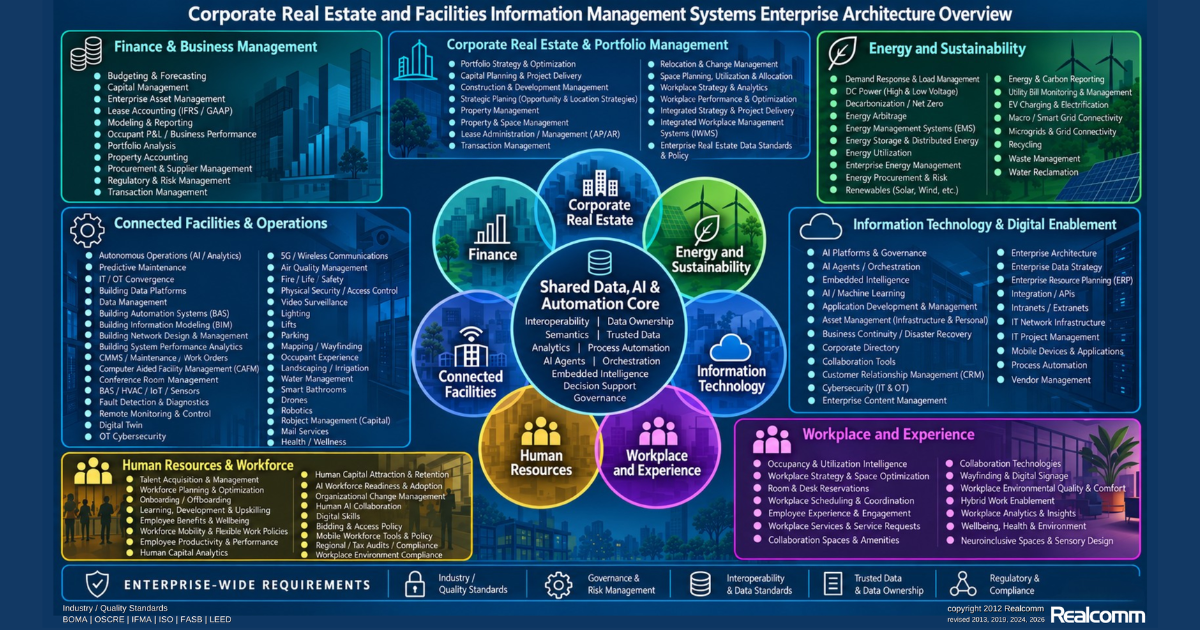
Realcomm's updated enterprise architecture framework offers corporate real estate leaders a practical starting point for assessing AI readiness and determining where to focus their efforts.
Corporate real estate and facility leaders are facing growing expectations around AI. Executives want to know where it can reduce costs, improve portfolio performance, streamline operations, and support better decisions. New applications and capabilities are emerging faster than most organizations can evaluate them.
Consider a question a company executive might ask:
Where are we spending the most on underutilized space across our global portfolio, and what could we realistically save through consolidation?
A meaningful answer requires reliable information about lease obligations, operating costs, occupancy, workforce requirements, and capital plans. In many organizations, that information resides in separate systems managed by different departments. Some of it is still tracked in spreadsheets.
AI can help analyze the information and identify opportunities. But how confident can leadership be in its recommendations if the underlying data is incomplete, inconsistent, or disconnected?
These are longstanding challenges for corporate real estate organizations. AI is making them harder to overlook.
An Enterprise Architecture Framework for the AI Era
For nearly three decades, Realcomm has examined how technology and information systems support commercial and corporate real estate. During that time, the industry has invested heavily in specialized applications for portfolio management, facilities operations, workplace services, financial management, and other business functions.
Despite those investments, many organizations still struggle to connect their systems and produce a reliable, enterprise-wide picture of their operations.
Realcomm's updated Corporate Real Estate and Facilities Information Management Systems Enterprise Architecture Overview brings these systems and their relationships into a single framework. It reflects years of work examining how technology supports the corporate real estate enterprise, and AI makes that work particularly relevant today.
"We've been talking about disconnected systems, data standards, and enterprise integration in real estate for decades. AI is forcing a much more focused conversation about what it will take to finally address these issues. If your systems can't share reliable information today, or become interoperable tomorrow, what happens when you start asking AI agents to make decisions and execute work across them?"
Jim Young, Co-Founder & CEO, Realcomm
The framework was developed to map the broader technology and information management environment. It also provides a way to examine what an organization has in place today, where important connections are missing, and what may need to change to support AI across the enterprise.
Why This Framework Matters for AI
The infographic maps eight interconnected areas of the corporate real estate enterprise, including portfolio management, facilities and operations, finance, energy and sustainability, workforce, workplace experience, IT, and the shared data, AI, and automation capabilities that support them.
Each area contains information and processes that AI can potentially improve. Many applications are already demonstrating value within individual functions, from workplace analysis and predictive maintenance to financial forecasts and workplace utilization.
The greater opportunities often involve information from several systems.
Take building operations. AI can identify equipment problems and recommend maintenance activities. When those findings are connected to repair histories, asset condition, capital budgets, and portfolio plans, they can also inform decisions about equipment replacement and future investments.
Or consider workplace utilization. Occupancy data helps organizations understand how space is being used. Combined with lease information, operating costs, workforce plans, and portfolio objectives, it can support more informed decisions about how much space an organization needs and where.
The infographic makes these relationships visible, including the shared capabilities required to support them.
At its center is the Shared Data, AI & Automation Core, encompassing interoperability, trusted data, semantic consistency, data ownership, analytics, process automation, AI agents, orchestration, decision support, and governance.
These are capabilities that may be delivered through multiple existing platforms and services. They do not necessarily require replacing current systems or building a single centralized technology platform.
What matters is whether the information and processes can work together effectively.
An AI application analyzing portfolio costs needs consistent definitions of rentable area, occupancy, and operating expenses. An AI agent coordinating maintenance activities needs access to equipment information, work order systems, and authorized workflows. Executives acting on AI-generated recommendations need confidence in the information behind them.
As AI begins operating across systems and business functions, these requirements become increasingly important.
Put the Framework to Work
One of the most valuable uses of the infographic may be as a working reference for corporate real estate leadership teams.
Put it on the table with leaders from CRE, facilities, workplace, finance, and IT, and start with a basic assessment.
What does our current environment actually look like?
Identify the major systems supporting each functional area. Where does critical information reside? Which capabilities are well established, and where are there gaps, overlapping applications, or manual processes?
Then examine the connections between those systems.
Can portfolio teams access reliable utilization data? Can building performance information inform capital planning? Are there consistent definitions across departments? How much effort does it take to produce a dependable picture of the entire portfolio?
The next step is to examine proposed AI initiatives against that environment.
An AI lease abstraction application may deliver immediate value with relatively limited integration. An initiative intended to optimize portfolio costs, space utilization, and capital investments across hundreds of facilities will likely require a much broader set of connected information and systems.
Understanding those differences can help organizations prioritize investments and avoid launching initiatives that depend on capabilities they have yet to develop.
The framework won't tell an organization which AI application to deploy first, how much to invest, or what its implementation timeline should be. Those decisions depend on business priorities, technical readiness, available resources, and expected returns.
It can, however, help leaders identify which underlying improvements will support their priorities and where investments may benefit more than one initiative.
Who Owns the Enterprise AI Roadmap?
There is another question the architecture brings into focus: Who is responsible for making all of this work together?
Corporate real estate may own portfolio strategy. Facilities manages buildings and operations. Workplace teams oversee employee experience. Finance controls budgets and capital planning. IT manages enterprise systems, integration, and cybersecurity.
Each function has its own priorities and responsibilities, yet many of the most promising AI applications depend on information and decisions that cross these organizational boundaries.
Consider an AI initiative intended to optimize space across a global portfolio. CRE may define the business objectives, workplace teams may manage utilization information, finance may evaluate the economics, and IT may oversee the technology and security requirements.
Who sets the priorities? Who funds the work? Who owns the data? And who is accountable for the results?
These questions become more pressing as AI agents move into operational workflows, potentially initiating actions or coordinating activities across multiple systems. Organizations need to establish what these systems are authorized to do, where human approval is required, and how decisions will be monitored.
The technology architecture is only part of the equation. Organizations also need a way to coordinate technology strategy and decisions across the business functions involved.
The infographic provides a common reference for that discussion.
Where to Begin
Realcomm's enterprise architecture framework is a reference model rather than a prescribed technology stack or implementation plan. Every organization will need to adapt it to its existing systems, portfolio, business priorities, and level of technical maturity.
For organizations beginning to develop an AI strategy, it can help identify foundational capabilities that need attention. For those already deploying AI, it offers a way to examine the dependencies that may affect expansion across business functions and portfolios.
AI is also giving organizations new reasons to address technology and information management problems that have existed for years. Improving data quality, connecting systems, and clarifying responsibilities can create value well beyond any single AI application.
For corporate real estate leaders wondering where to begin, a worthwhile exercise may be to put this architecture in front of their leadership team and ask: How much of this actually works together in our organization today?
Continue the Conversation at CoRE Tech 2026
Building an enterprise AI roadmap will be a central focus of CoRE Tech 2026, December 8–9 at Blanco Urban Venue in San Jose, California.
Join corporate real estate, facilities, workplace, and technology leaders to explore how organizations are developing AI strategies, connecting enterprise data and systems, establishing governance, and integrating AI into real-world business and operational workflows.
Through practitioner-led discussions and implementation case studies, we'll examine the decisions, challenges, and practical lessons involved in moving from individual AI applications toward enterprise-wide capabilities.
Explore the conference: CoRE Tech.

|
Sarah Bemporad, Strategic Director Content Development & Production, Realcomm
Sarah Bemporad is Strategic Director of Content Development & Production at Realcomm, where she develops conference programs and educational initiatives that bring together commercial and corporate real estate leaders and technology providers. Her work spans areas including artificial intelligence, smart buildings, cybersecurity, workplace technology, and digital transformation, with a focus on knowledge sharing, collaboration, and practical industry experiences. Prior to joining Realcomm, Sarah worked at Paramount Group in New York. |
This Week’s Sponsor
Yardi® develops and supports industry-leading investment and property management software for all types and sizes of real estate companies. Established in 1984, Yardi is based in Santa Barbara, Calif., and serves clients worldwide. For more information on how Yardi is Energized for Tomorrow, visit yardi.com.
Read Next
 11/11/2026
What Happens When You Ask Your Lease and Ledger Data a Question In commercial real estate, questions tend to arrive before the reports that answer them.
 11/4/2026
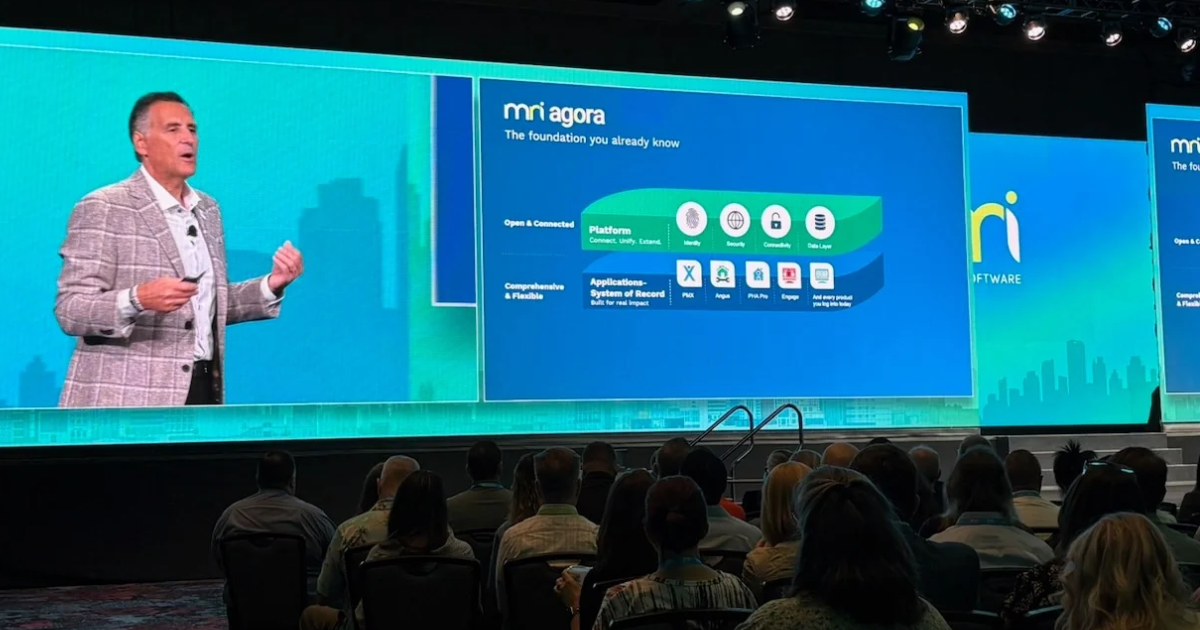
MRI Software Showcases Agentic AI and Workflow Automation at Ascend 2026 For real estate software providers, the next phase of artificial intelligence may be less about answering questions and more about getting work done.
 10/14/2026
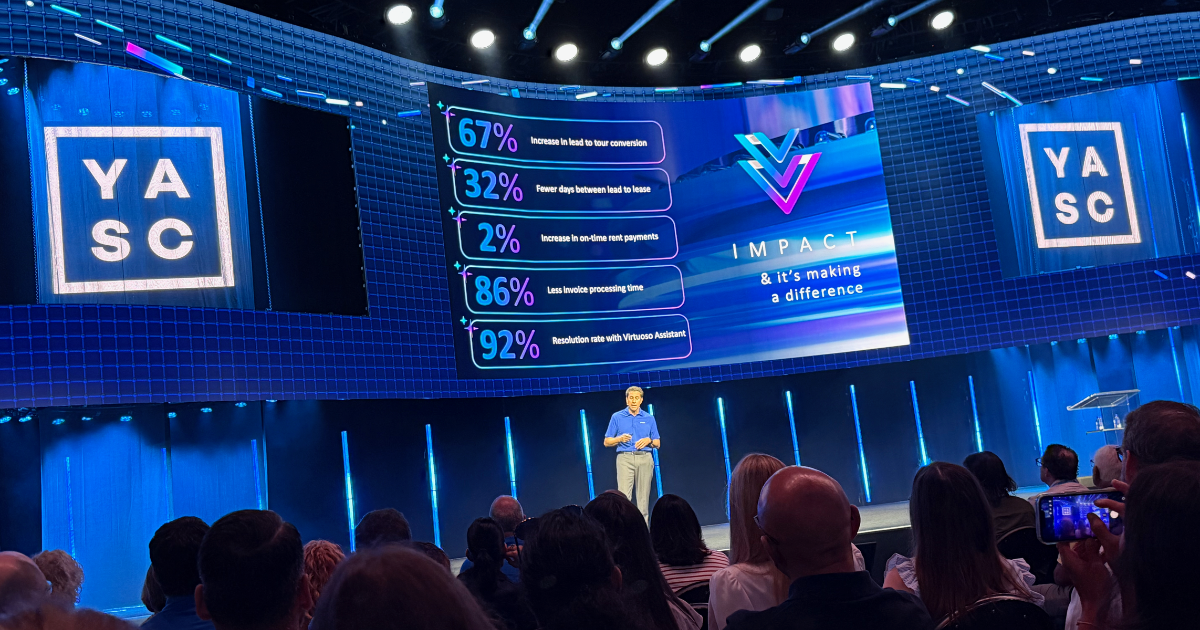
Yardi’s AI Strategy Takes Center Stage at YASC 2026 With the introduction of Virtuoso Enterprise, Yardi is positioning AI as a foundational component of its real estate technology platform, offering customers multiple paths to adoption.
 9/30/2026
The Truth Is in the PDF AI has transformed what we can do with data. So why do we all still live in a sea of PDFs?