



The Truth Is in the PDF

 Listen to this article
AI has transformed what we can do with data. So why do we all still live in a sea of PDFs?
Most CIOs I talk to have run the same experiment. Someone drops a lease into a chat window and asks when the next rent step hits. The answer comes back in four seconds, correct, with the clause quoted. The room gets quiet in the good way.
For that one question, on that one document, the problem really is solved. If that is all you need, the tools you already have are good, and you should use them.
But notice what actually happened. The AI read the document. It did not turn it into data. Nothing landed in your systems, nothing can be compared across your portfolio, and tomorrow someone will ask the same question again. So the PDF stays open.
Your system of record is a copy
We have spent twenty years building systems of record: the property management platform, the valuation model, the loan servicing system. Now watch how people actually work. Someone on the asset management team has a lease PDF open in one window and the rent roll in the other, all day long. They do it because they know, even if nobody says it out loud, that the system is a compressed copy of the documents. The documents are still the truth.
Compressed copies fail in two ways. The first is drift. Recently my team audited the rent roll of a 500-unit multifamily property against the data room behind it — roughly 5,000 leases, addenda and related documents. About a third of the units had something that did not match, worth roughly $150,000 a year in cash flow and $2 to $3 million in value. Nobody did anything wrong. The gap accumulated one amendment at a time.
The second is detail that never made it into the system in a usable form. The system knows the rent as a number. It may know the termination right too, as a sentence pasted into a notes field or a Word abstract that is just another document. What it cannot tell you is which tenants can terminate in the next eighteen months, on what notice and at what cost. The terms were captured as text, not as data, so no report can see them.
The opportunity is not automating the copy you already have. It is capturing what the copy left out.
What becomes possible when the documents become data
Once the detail in your documents becomes data, questions that used to take a team a month become things you can simply ask.
You know the ground truth. A lease with three amendments, a side letter and an estoppel. A loan agreement and the modification that changed a covenant. Today, the answer to "what does this actually say?" lives in someone's head after a long afternoon of reading. Reconciled across the whole chain, it becomes a fact you can check the system against, at acquisition, at a management takeover, or before the budget is set.
You can model what the agreement actually says. A joint venture operating agreement with a preferred return, a promote and a catch-up. A loan agreement whose cash flow waterfall depends on definitions forty pages away. Captured properly, those terms become a calculator you would put in front of an investor, not a summary you hope is right. The hard part is following a defined term to the section it modifies to the exception that overrides it, and knowing you caught every link in the chain.
You own a dataset nobody else has. Thousands of offering memoranda. Every appraisal your firm has commissioned in a decade. Individually unremarkable. Together, a view of your market your competitors cannot buy, provided every document lands in the same shape. A rent step can be written as a fixed amount, a percentage, a CPI increase with a floor and a cap, or a schedule buried in an exhibit. Until they are all expressed the same way, you cannot compare them.
The value is real, and so is the last 30 percent
This data was never captured for a simple reason. Paying people to read and key every clause of every document cost more than the answers were worth. AI changed that math, and the firms that capture this data first get to use it while everyone else is still reading.
With a good model and a free weekend, you can get 60 or 70 percent of the way there, and for plenty of questions that is good enough. The rest is harder because extraction is only the first step. The data has to land in your layout, not the model's. Terms that look alike have to stay distinct: a renewal option is not an extension option, and a CAM cap is not an expense stop, even when the language blurs them. And it has to work the same way on document 4,000 as on document 4, without someone rewriting prompts every time a new format shows up. That is not prompting. It is a data pipeline.
The failure mode changes, too. Old workflows failed loud. Models fail quiet. An empty field or an error message told you to go look. A wrong answer delivered with confidence is worse than nothing — because across a thousand documents, you cannot tell which answers are which.
That is why accuracy has to be observable. Every extracted term should trace back to the exact page and clause it came from, with a flag when documents disagree or the answer is uncertain, and every change should be tested against answers you already know are right, so fixing one problem does not quietly create another. Without that, you have just built a second copy you cannot trust.
Three questions worth asking your team
- When someone needs a definitive answer, do they open the system or the PDF?
- Is there a question you would ask across your whole portfolio if your documents were data?
- If a model gave you a wrong answer, would you know?
If the honest answers are "the PDF," "yes" and "I'm not sure," you are in good company. For now, that is most of the industry. The advantage goes to whoever moves first.

|
Ross Goldenberg, CEO, Kernel Intelligence
Ross Goldenberg is co-founder and CEO of Kernel Intelligence, which turns complex real estate documents into structured, verified data. A serial founder with deep roots in CRE data and compliance, he previously co-founded SiteCompli, acquired by Insight Partners in 2019, and Synco, also acquired. Ross is an adjunct professor at Columbia Business School and writes about AI and entrepreneurship for founders and operators. |
This Week’s Sponsor
Unframe is on a mission to reinvent software through the power of AI. We deliver secure, scalable solutions that integrate seamlessly with your systems, empowering every organization to drive AI-native innovation across the enterprise.
Read Next
 10/14/2026
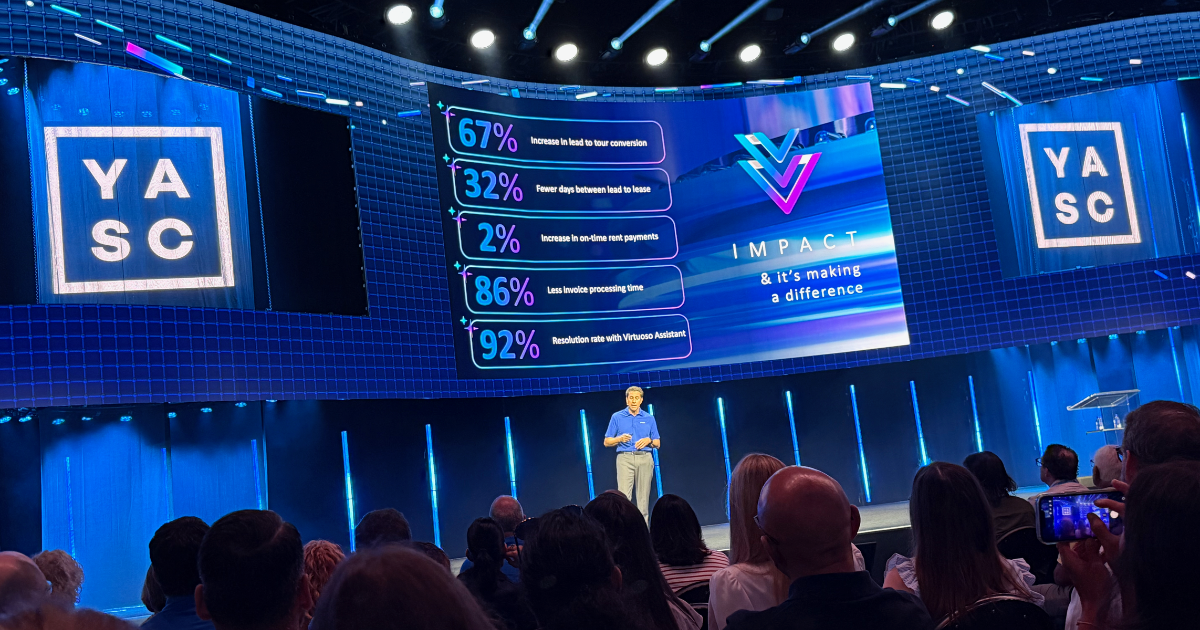
Yardi’s AI Strategy Takes Center Stage at YASC 2026 With the introduction of Virtuoso Enterprise, Yardi is positioning AI as a foundational component of its real estate technology platform, offering customers multiple paths to adoption.
 9/23/2026
How to Put a Better Building Experience in Your Tenants’ Hands Many commercial buildings have spent the last five years adding tenant experience solutions but most of them have the same problem: the apps run on their own data.
 9/16/2026
From CIO to Orchestrator in Chief: How today’s real estate tech leaders are making change make sense Today’s CIOs operate amid sustained complexity. Portfolios are more distributed, data is more interdependent, and expectations from executives, investors, operators, and residents continue to rise.
 9/2/2026
Are We Far Behind in Our Smart Building Strategy? There is a question every building owner, facility executive, engineer, system integrator, and technology provider should be asking: Are we far behind?